Showing posts with label images. Show all posts

Saturday, March 13, 2010

Cased Images and Opera Images

Rather than creating a new post for the opera images I scanned last week, I edited my March 8th post to include images from these productions.

I am, however,creating a new post for the cased images we looked at on March 2nd.

Here is a scan of the photographs of Madison and Lucinda Evans. These are the photographs which have the slightly mysterious text underneath them.


***
The subject of this photograph is E. Jennie Hoover. It was taken in 1855.


***
The subject of this photograph is Eliza Jane Sluss Hoover. An interesting bit of trivia: because of the photographic process used to create them, daguerreotypes are usually reversed. This reversal can often be observed by looking at the hands of the subjects of the photographs. If the person is married, his or her ring will appear to be on the right rather than the left hand. We corrected for this by flipping the scan in Photoshop, so Eliza Jane Sluss Hoover's ring appears on the correct hand. You can also see that her rings have been tinted silver.


Tuesday, March 9, 2010

Monday, March 8, 2010

I spent today scanning negatives of opera productions again, which was a nice change from scanning sports negatives. Going through these images really makes me wish I'd had the opportunity to see more operas at Indiana University during my time here--it looks like they always put on amazing productions.

I scanned images of the 1999 production of Gianni Schicchi, the 1999 production of Suor Angelica, and the 2001 production of Faust. In this post, you can see one image from Suor Angelica (the nuns) and two images from Faust.

Tuesday, March 2, 2010

Today, Brad and I looked at some of the oldest images in the archives--a box of cased images. The examples we looked at included daguerreotypes, ambrotypes, and tintypes. Brad explained how to distinguish between the three types, and showed me how to safely take apart cased images by using a suction cup to gently lift the image from its case rather than attempting to pry it or shake it out of the case, both of which can damage the case. Lifting the image from the case sometimes reveals information about the subject of the photograph or the photographer beneath, so we went through all the images and checked for this kind of information beneath.

The cased images are really fascinating. I especially liked the daguerreotypes--I think they're a little eerie. At certain angles their subjects become almost invisible in the mirrored surface of the photograph, and instead you see your own face reflected back at you.

Lifting out the images is fun, since you never know what you'll find underneath. One of the cased images we examined had portraits of Madison Evans and his wife, and the inscription beneath one of the photographs was a little mysterious--inside three hearts, someone had written the following information: "E&H Jan & Feb 1880," "Ring performance by L July 29, 1880," and "Lost 1880 June 9th." We're not sure what any of that means, but hopefully I'll uncover something when I start researching Evans.

We scanned some of the cased images, but I forgot to email them to myself, so I'll post about the cased images in more detail later when I can include the scans.

For some of the images, we only know the names of the subjects, so sometime within the next few weeks, Brad will have me work on researching those subjects to see if I can uncover any more information about the people pictured.

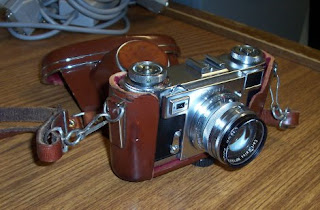
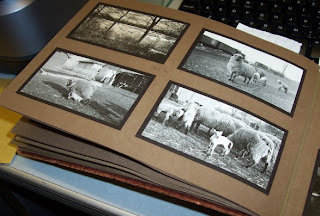
We also looked through a photo album of Charles Cushman's early work and Cushman's camera. In this post, you can see a photograph of Cushman's camera and a photograph of a page from his album. Only a few of his early black and white photographs are currently available on the Cushman website.

We also looked at some Indiana University photo albums from 1881 and 1885, one of which contained small, "carte de visite" photographs while the other included larger "cabinet cards." Brad showed me how to safely remove photographs from these types of albums, since these types of photographs often have information about the photographer on their backs.

Tuesday, March 2, 2010

Monday, March 1

I started today by scanning a few negatives of a football game and a football player for the Hall of Champions, another sports exhibit which is being installed on the Indiana University campus. This project will require images of all university sports rather than just basketball.

I also continued working on going through the Photoservices contact sheets and transferring the information from the contact sheets to the negative envelopes in preparation for scanning these negatives and entering them into the new photographs database.

Today I worked on images of the construction of the Herman B. Wells Library. It was really interesting to see areas I walk through every day under construction! Here you can see a photograph taken on August 3rd, 1967 of a partially completed Main Library. This is a scan of the contact sheet. Once all the negatives have been scanned, the images added to the new photographs database, and the information entered into the database, these prints will no longer be needed except for exhibit purposes.

Monday, February 22, 2010

Today I finished going through all the sports contact sheets, which end in 1997. Once I had all the contact sheets that included photographs of IU women's basketball teams, I pulled the corresponding negative envelopes and began scanning them.

I am including in this post an image of a contact sheet like the ones I have been examining. These contact sheets reproduce the negatives in actual size, but as positive images. While these images are small, they are much easier to examine than the negatives and, unlike the negatives, they do not require careful handling since they are only reference prints.

This particular contact sheet shows a men's basketball game at Indiana University on February 5th, 1972 during which Indiana University played against Michigan State.

At the upper right corner, you can see the negative number. Both the contact sheets and the negative envelopes are arranged by these numbers.

Sunday, February 21, 2010

Monday, February 15, 2010

Today I continued identifying the photographs of women's basketball teams I scanned last week. The photograph shown in this post was labeled 77-298.3. (The "77-298" portion of the number appears on the negative envelope and indicates that the photograph was taken in 1977. The ".3" portion indicates the specific negative in that envelope which the image comes from.) The actual scan is of much higher quality. Not only is this image less than a third of the size of the actual scan, it also became very grainy because the old version of Paint Shop Pro I have can't handle tiff images. I had some trouble working around that to get a version of the image I could open in my paint program and save as a jpeg to upload to this blog.

This photograph was taken in 1977, but I haven't yet identified which team it depicts. Some of the earliest years of women's basketball did not have media guides produced for them and some of the early media guides did not include team photographs, which makes it more difficult to identify some of these photographs from the 1970s.

The AskSam database only gave me images up to 1986 when I performed a search for women's basketball team photographs. However, this does not mean that there are no photographs of the women's teams after this date, just that they have not been entered into the database. The only way for me to locate these later images is to go through all the sports contact sheets for the years we need and look for photographs of the women's basketball teams. I started doing that today. Since there are hundreds of contact sheets for each year, this will be a long process.

Wednesday, February 3, 2010

Wednesday, February 3, 2010


Today I continued working on scanning negatives and slides of women's basketball for the exhibits in the basketball practice facility, which is scheduled to open sometime in March. So far, I have scanned all the images of women's basketball from 1972 to the beginning of 1976 that looked like they might be acceptable for use in the exhibit.


Since it takes time for each batch of negatives and slides to scan, I continued working on transferring information from the Photosevices collection prints to the negative envelopes while the scanner was working. This time I was working on a folder of prints showing the construction of a power plant on campus.

The new computer and scanner have also been installed in the photo archives (see pictures at right). I haven't used the new scanner yet, but it is supposed to be better for scanning slides. Also, now that we have three workstations, we will be able to work on projects requiring the use the Ask Sam database while the other computer and scanner are occupied with scanning. (No other programs can be used while images are being scanned.)

Tuesday, January 19, 2010

Tuesday, January 19, 2010

Today I finished scanning the slides of opera productions. I'm including an image from a 2001 production of Madame Butterfly. It looks like it was a really beautiful show! To give you an idea of the level of detail in the actual scans we're creating for the opera department, that image is saved at 400 dpi (it's been shrunk a little even from that for this blog--click on it to see it at 400 dpi). The full-sized scans are 2400 dpi.

Now that the opera project is complete, I'll be working on scanning images of IU basketball games and players for the new basketball practice facility near Assembly Hall. The lobby of the practice facility will include exhibits on basketball throughout IU's history, so we are finding and scanning images to be used in the exhibits.

The previous negatives I'd worked with were all 35mm, but many of the basketball images are 120mm. The process for scanning them is basically the same, but they are scanned at 1400 dpi rather than 2400 dpi, since they are larger.

Tracking down the images for these basketball exhibits can be a pretty elaborate process. We're given the names of players and games of which the athletic department would like to have pictures, and then we try to locate appropriate images. Photographs in which each subject is identified, such as photographs of the entire team or individual portraits, can be located relatively easily by searching the IU Archives' "Ask Sam" database, but action shots of particular players are a little more difficult to find. Brad keeps the media guides released each year for the sports played at IU, and we have a guide put together by a local IU basketball enthusiast that lists by season every basketball game played at IU with the date and final score for each game, as well as all the people on the team that season with their jersey numbers. It's a really fantastic tool.

When someone wants images of a particular player, we use this guide to determine what years he played and what his jersey number was. Photographic Services photographed IU home games, so we go to the files of reference prints in the Photographic Services sports collection, and start going through the file for each year during which the player was on the team to locate the photographs of basketball games. These reference prints often contain many images on one sheet, so we use a loupe (a kind of magnifier) to examine each image for good shots of that player, whom we identify by his jersey number. It can be pretty painstaking work. I spent part of my day today going through photographs of games from the 1960s looking for good images of two particular players.

Tomorrow we're supposed to get a new computer and scanner installed, so it should be an exciting day!